Corporate Governance
Basic Policies on Corporate Governance
The ACOM Group, guided by its lifelong "Circle of Trust" spirit, maintains an ongoing corporate commitment to respecting other people, putting the customer first, and conducting creative and innovative management. Based on this commitment, we are seeking to deepen mutual trust between our stakeholders and ourselves and thus progress in partnership with society.
In order to meet the expectations of stakeholders and build stronger trust, we will strengthen corporate governance as a key management priority. To this end, we will take steps to enhance the soundness, transparency, and efficiency of our operations and achieve sustained increases in our shareholder value.
We recognize that effective internal control systems are essential to creating an appropriate corporate governance framework. Based on this recognition, we are encouraging all members of our organization to join forces in building internal control systems and assuring their effectiveness, under the leadership of management. At the same time, we are constantly evaluating, verifying, and improving the effectiveness of internal control mechanisms already in place.
- Corporate governance report submitted to Tokyo Stock Exchange (Last updated on June 29, 2026) (880KB)
- Basic Policy of Establishing ACOM Group's Internal Control System (Last updated on April 1, 2025) (112KB)
- Basic Policy for the Internal Control over Financial Reporting (Established on December 18, 2007) (74KB)
- Independent Officers Notification (Submitted on June 4, 2025) (103KB)
Reasons for Non-compliance with the Principles of the Corporate Governance Code
- [Supplementary Principle 4.10.1 Independence and Authority Roles of the Appointment Committee and Renumeration Committee]
- ACOM has Appointment and Remuneration Committee in place as optional committee in charge of appointment of and compensation for senior management and directors. The committee deliberates and proposes the appointment candidates and remuneration for Directors to the board of Directors, under the policy of the Appointment and Dismissal of Senior Managements and candidates for management and the Policy of Determination of Compensation to Senior Managements and Directors, in consideration of the advice of independent outside directors. The Appointment and Remuneration committee consists of six members including two independent outside Director. Although Independent outside directors do not constitute the majority of Appointment and Remuneration Committee, the Company ensures their appropriate involvement and receives their suitable advice upon consideration of appointment and remuneration.
Disclosure Based on the Principles of the Corporate Governance Code
- [Principle 1.4 Strategic Shareholdings]
- The Company currently does not have any strategic shareholdings and does not plan to do so in the future.
- [Principle 1.7 Transactions with Related Party]
- Pursuant to relevant laws, it is provided in our regulations of board of directors that transactions with directors and material transactions with major shareholders require prior approval of the board of directors.
- [Supplementary Principle 2.4.1 Ensure Diversity in the Appointment of Core Human Resources]
- <Approach to Ensure Diversity>
Under the situation where competition between companies is intensifying and changes in needs are accelerating, in order to implement "creative and innovative management" that the Company advocates in its corporate philosophy, and to continue to meet the expectations from stakeholders, it is necessary to develop human resources who embody its corporate philosophy by respecting abilities, ideas and values from diverse human resources.
With that in mind, ACOM is actively taking measures to secure diversity, including advancement to manager and human resource development of female and mid-career employees. - <Status of Voluntary and Measurable Goals for Ensuring Diversity>
To ensure the diversity of core human resources, ACOM has set the following targets for the ratio of females and mid-career hires in managerial or higher positions. -
Category As of March 31, 2026 By March 31, 2028
(Target)Percentage of Females in managerial positions (above assistant manager) 25.0% 26.5% Percentage of Mid-Career Hires in managerial positions (above assistant manager)* 8.7% Increase from current level *For the purpose of this tabulation, mid-career hires are defined as "those who joined the company mid-career and have been with the company for 10 years or less.
- < Human Resource Strategy and Policies on Human Resource Development, Workplace Environment Development, and Compensation to Ensure Diversity>
The ACOM Group promotes its operating activities with an aim toward "Contributing to the Realization of an Enjoyable and Affluent Personal Life, and to Improving Lifestyle," based on the corporate philosophy of "The Spirit of Human Dignity," "Customers First," and "Creative and Innovative Management," under our founding spirit of "Circle of Trust." In addition, in order to achieve our vision of meeting the expectations of all stakeholders, we adopted "Accelerating Our Growth Cycle to Achieve Our Vision" as our medium-term policy with the fiscal year ending March 2026 as the initial year.
With respect to business promotion, we recognize that human capital management is essential, supported by human resources who can embody our corporate philosophy. In addition to hiring individuals who align with the Group's philosophy, we have been promoting a human resource strategy associated with our business and functional strategies to address the acceleration of growth under the medium‑term management plan, placing importance on employees' continuous, self‑driven growth.
In promoting our human resource strategy, we aim to strengthen foundation of human resource, with recruitment, development and retention as the core. Regarding recruitment, we have been taking steps to further enhance our brand strength and expand information disclosure, in order to secure human resources with diverse values and ideas. With regard to development, we have been enriching our training programs while also creating an environment that supports employee's growth, in order to develop a self-driven culture. Furthermore, in terms of retention of human resources, we have been working to enhance employees' engagement, while developing an open corporate culture through various employee benefits and an evaluation system that rewards taking on challenges and achieving results.
For these activities, we have organized them into five domains and are promoting initiatives in the areas of "Recruitment and Development of Human Resources," "Work Style Reform," "Diversity and Inclusion," "Personnel Evaluation and Compensation," and "Employee Engagement."
Across the ACOM Group companies both in Japan and overseas, we aim to share common values by utilizing our employees and perspectives, while hiring and developing human resources according to each business type and the characteristics of each location.
Based on this thinking, we aim to improve a sustainable corporate value within the ACOM Group.
〔Policy on Human Resource Development〕
Aiming for the Company Group's sustainable growth, the Company will respect the abilities, ideas, values, etc. of diverse human resources and develop human resources who can embody its corporate philosophy.
〔Policy on Workplace Environment Development〕
Based on the Group's corporate philosophy of "The Spirit of Human Dignity," the Company will promote diversity and develop an internal environment in which employees can feel motivated and comfortable.
〔Policy on Compensation〕
This policy has been established to hire, develop and retain human resources who can support our sustainable business growth and the enhancement of corporate value, through a human resource strategy based on our corporate philosophy, vision and medium-term management plan. Employee compensation consists primarily of monthly salary and bonuses, which are in principle paid twice a year. Compensation is determined based on employees' roles and evaluations that appropriately reflect their performance and challenges. Our evaluation system is designed to be fair and balanced, ensuring that employees' achievements and efforts are properly recognized. Compensation levels are set in consideration of the business environment, social conditions, and other relevant factors. In addition, we work to enhance our employee benefits programs to further improve work engagement.
〔Specific Initiatives〕
(Recruitment and Development of Human Resources)
○Enhancing recruitment activities for new graduates and mid-career hires
Under the situation where competition between companies is intensifying and changes in needs are accelerating, in order to implement "creative and innovative management" and meet the expectations of stakeholders, we believe it is necessary to create a new value by fusing abilities, ideas, values, etc. of diverse human resources. Based on this thought process, we are promoting recruitment activities for new graduates and mid-career hires to secure the necessary human resources to carry out business strategies and further enhance corporate value. We engage in creating working environments which provide job satisfaction and workplace comfort.
As for recruitment activities for new graduates, in addition to our previous job requirements, we aim to secure diverse human resources by considering our human resource portfolio and building talent-pool for future business development. In addition, we have actively shared corporate information by launching our official YouTube recruitment channel and Instagram account, featuring office introduction videos, employee interviews, and more, in order to enhance our brand image and recognition among job seekers. As a result of these activities, we ranked second place in the "Credit, Consumer Credit, Leasing, and Other Finance" category of the "MyNavi/Nikkei 2027 Ranking of Popular Employers for University Graduates."
In our recruitment activities for mid-career hires, we actively recruit human resources with specialized skills to speedily respond to operational issues and seek further expansion in each business domain. We will strive to ensure diversity and maximize organizational capabilities in the future.
• Trends in the number of new graduates and mid-career hires
FY2021 FY2022 FY2023 FY2024 FY2025 New Graduate 64 63 78 87 104 Mid-career hires 34 36 55 96 91 (Notes) New graduate recruitment is the number of employees who join the company on April 1 of the next fiscal year.
○Developing digital talent for optimization both human resources and digital
We are confident in the Company's credit and collection capabilities, as well as the know-how cultivated through our long-term business operations as a leading company in the consumer finance industry. On the other hand, we recognize that it is a pressing matter to build an organization that can respond quickly to digitalization, technology innovation and changes in the market environment, and we have been strengthening the development of human resources who will be part of the promotion of digital technologies. Since April 2023, we have been running the "Digital Human Resource Development Program." In this fiscal year, we provided training programs to help employees, selected based on their performance in the basic digital training, acquire more advanced professional skills (data analysis, programming, AI, UI/UX, etc.) and dispatched them to cross-boundary learning.
In addition, with the aim of improving digital literacy across the Company, we have enhanced the organization's adaptability to change through qualification programs related to both IT and statistics, as well as study programs on generative AI.
• Trend in the number of employees holding digital‑related certifications (since 2022)
FY2022 FY2023 FY2024 FY2025 No. of employees holding certifications 205 315 382 452 (Notes) The digital-related qualifications counted include Japan Information Technology Engineers, Statistics Certification, AI Certification, Python-related certifications, etc.
○Promoting development of future leaders
In this fiscal year, our executives have worked together as a unit, we have established a framework that promotes early development of future leaders who will contribute to the Company Group. Specifically, we have been promoting the following two measures.
- Executive‑led initiatives
We are strengthening our traditional OJT by providing practical opportunities such as subsidiary management assignments and "tough assignments" (appointments to key projects, etc.). In addition, we have newly introduced dialogue sessions and one‑on‑one meetings with executives. Through direct guidance and communication from executives, we aim to ensure the transfer of management perspectives to the next generation of leaders.- HR‑led initiatives
In addition to existing training programs, we provide opportunities for internal lecture and interactions with external professionals. Through these practical experiences, we aim to further promote employee growth.
(Work Style Reform)
○Promoting male employees taking childcare leave
With the goal of achieving a 100% childcare leave utilization rate among male employees, we carried out efforts such as providing information for managers to promote understanding of childcare leave for male employees and introducing information tools related to DEI and healthcare, in order to create an environment that facilitates childcare leave for male employees and to promote its utilization.
Regarding the calculation of the childcare leave utilization rate for male employees, differences between the fiscal year in which a spouse gives birth and the fiscal year in which childcare leave is actually taken may affect the figures for a single year. We will continue to enhance the effectiveness of our initiatives so that all eligible employees can take childcare leave comfortably at the timing they desire.
In addition, as part of our support system for smooth returns to work and continued career development, we revised the support program for early returnees. Instead of providing benefits through bonuses as in the past, we shifted to monthly salary payments to promptly reduce financial burdens such as childcare fees, thereby supporting employees in continuing their desired career paths. Furthermore, we have strengthened our support structure to meet diverse needs, including adopting the Children and Families Agency's "Babysitter Dispatch Program Discount Vouchers" as part of our employee benefits.
○Promoting health management
We believe that the physical and mental health of employees leads to happiness for employees and progress for the company. Based on this belief, we have established our Health and Productivity Management Policy ("Declaration of Health and Productivity Management"). Under this policy, we work to promote early detection and prevention of illness by subsidizing the cost of comprehensive medical checkups and cancer screenings. We also support improvements in exercise and dietary habits through the use of a health management portal site, encourage the establishment of exercise routines through walking events, and host health related events in collaboration with business partners. Through these multifaceted initiatives, we strive to create a work environment where employees can thrive and fully demonstrate their abilities.
As a result of these ongoing efforts, we were selected as one of the "2026 Outstanding Organizations of KENKO Investment for Health (White 500)," an honor awarded to the top 500 companies among the large enterprise category certified under the recognition program for a Superior Health Management Corporation jointly administered by the Ministry of Economy, Trade and Industry and the Nippon Kenko Kaigi.
In addition, the Company has been recognized as a "Superior Health Management Corporation" within the large enterprise category for the fifth consecutive year, and we will continue to enhance our health promotion initiatives and work to further increase corporate value.
(Diversity & Inclusion)
○Female advancement
The Company has been promoting the "Woman Career Program" since the fiscal year ended March 31, 2023. The training program is designed to create an environment where female employees can work with vitality by supporting their autonomous career development. As of the current point in time, a total of 62 female employees have completed the program. Among the 35 participants eligible to apply for selective training programs, 17 employees, which is about half of the eligible participants, voluntarily applied for the management‑candidate development program. Through this program, we are fostering a mindset aimed at becoming next-generation leaders and translating it into concrete actions.
As a result of these ongoing development initiatives, the advancement of female employees has steadily progressed. The ratio of female managers reached 10.0% (an increase of 4.5 percentage points from the fiscal year 2021), and the ratio of female employees in positions at the assistant manager level and above reached 25.0% (an increase of 6.5 percentage points from the fiscal year 2021). We will continue to strengthen the pipeline of future female leaders and accelerate efforts to ensure diversity within decision‑making layers.
○Promoting opportunities for senior employees
To create an environment in which senior employees with specialized skills can thrive, we have introduced a system that determines compensation based on the level of specialization. In addition to the existing "Specialist Positions" (for example: system development, accounting), we newly established the "Expert Position," which allows employees to leverage practical experience such as customer service. This system enables us to provide appropriate treatment based on each senior employee's extensive experience and skills.
Furthermore, we expanded opportunities for long‑term engagement by raising the upper age limit to 70 for employees who meet certain criteria. Through these measures, we aim to support senior employees in contributing over the long term.
○Follow-up system for employees with disabilities
To ensure that employees with disabilities can feel motivated and comfortable in the work environment, we have established a support framework that includes conducting an annual workplace survey and holding multiple interviews each year with both their supervisors and the human resources department. Through these initiatives, we strive to build a workplace where employees respect one another as professional partners and where healthy, open communication is encouraged with attention to both physical and mental well‑being.
In addition, in order to further promote the understanding and adoption of diversity and inclusion, we provide internal e‑learning on universal manners and actively share information about programs led by MUFG. Through these ongoing efforts, we continue to foster an organizational culture that respects diversity.
(Personnel Evaluation & Compensation)
○Increasing employee compensation
The company positions the recruitment and retention of human resources who lead sustainable growth, as well as the enhancement of employee engagement, as one of its highest priorities. Based on this approach, we raised overall wage levels and implemented base salary adjustments with the aim of renewing our compensation structure to ensure competitiveness in the market.
- Strengthening recruitment competitiveness through higher starting salaries
To enhance our competitiveness in the labor market, we increased starting salaries.
(for example: General affairs who graduated university: 270,000 yen → 300,000 yen)- Base salary adjustments for existing employees (base‑up and elimination of pay gaps)
Following the increase in starting salaries, we implemented base salary adjustments of 18,000 to 30,000 yen, primarily for younger and mid‑career employees, to maintain appropriate compensation levels aligned with each qualification and role.- Optimization of the compensation structure
We expanded the range of individual performance‑based bonuses and increased differentiation in bonus multipliers for managers (section manager level and above). This shift enhances the attractiveness of compensation for higher‑level roles and strengthens the link between individual performance and rewards.
• Compensation increase rate (base salary growth rate) *1>Apr. 2023 Apr. 2024 Apr. 2025 Apr. 2026 5.2% *2 4.9% 4.1% *3 5.4% *1 The increase rate includes regular salary increases.
*2 Base salary increases, excluding regular salary increases were brought forward from payment of October 2022.
*3 In addition to revising base salaries, beginning with the summer bonus for fiscal year 2025, we will raise the standard amount for individual performance based pay (the base amount used for bonus calculations) for nearly all job grades, thereby improving compensation on an annual income basis.
○Building a system that rewards performance
We aim to build an organization in which each employee can demonstrate even higher performance by enhancing motivation and job satisfaction through a system that better rewards individual effort and achievement. In this fiscal year, in addition to responding to compensation increases, we introduced a new framework that appropriately evaluates employees' challenges to accelerate the growth cycle.
Through these initiatives, we promote a culture that encourages autonomous challenges and create an environment where employees can deliver high performance, contributing to improved organizational productivity and sustainable corporate value.
○Introduction of the "IT and System Skills Certification Program"
The Company has introduced the "IT and System Skills Certification Program" with the aim of supporting the digital shift and strengthening the recruitment and retention of IT talent. Under this program, employees with advanced expertise are certified according to their skill level, and compensation based on market standards are provided to ensure a competitive reward structure. Through rigorous annual skill assessments, including renewals and revocations, we encourage employees to pursue continuous self‑development and maintain a performance‑driven environment that rewards challenge and achievement.
(Employee engagement)
○Sharing the new action guidelines
To embed the newly updated action guidelines introduced in this fiscal year, the Company is promoting initiatives that unite management and frontline employees in driving their adoption across the organization.
First, we held round‑table discussions between the President and managers at the deputy general manager level and above. During these sessions, participants declared the principles they would personally lead by and shared best practices from within their departments, fostering a shift in mindset among the leaders. Furthermore, all departments implemented the "Action Guideline Embedding Program." After reaffirming the background of the initiatives and the expectations for employees through a video message from the President, departments conducted dialogue‑focused workshops. Through this series of activities, employees recorded their insights in the "Notebook for Creating the Future" and made concrete action declarations. By translating these principles into daily workplace behavior, we are working to enhance engagement across the entire organization.
○Employee engagement survey
Since 2019, we have conducted an annual employee engagement survey to measure expectations and satisfaction levels and to monitor organizational engagement trends. The survey utilizes "Motivation Cloud," provided by Link and Motivation Inc. We have been recognized for seven consecutive years in the "Best Motivation Company Awards" within the large enterprise category (companies with fewer than 5,000 employees). Based on survey results, executives, division heads, and the HR department work closely together to drive initiatives that enhance engagement for both employees and the organization.
○Supporting growth and challenges
The Company believes that providing incentives for employees to take on challenges and aiming to be an organization that practices "Creative and Innovative Management" leads to enhancing corporate value. We have been holding a business contest "DRIVE" across the ACOM Group since the fiscal year ended March 31, 2024. In this fiscal year, which marked the second round of the program, we received 71 applications.
Additionally, we launched the "PRO Conference," an innovation forum involving seven executive officers and 56 employees selected by executives. Led by executives with extensive expertise, the conference strengthens the feasibility of proposals. Of the seven proposals adopted through the conference, two have already been approved for implementation, with others under continued review.
Through these multilayered initiatives, we aim to cultivate an organizational culture where every employee continues to take on challenges.
- [Principle 2.6 Functioning as an Asset Owner for Corporate Pension Plans]
- The Company has Corporate Pension Asset Management Committee in place to effectively manage corporate pension asset. The committee comprises of the director in charge of Human Resources Dept. and chief general managers of Human Resources Dept., Corporate Planning Dept., Finance Dept. and Accounting Dept.
The members of the committee need to deepen their understandings on investment theory, asset management system, contents of asset for investment, etc. They also need to grasp asset management environment. Therefore, the Company provides necessary information from trustee management institutions to committee members in periodic manner.
The committee discusses basic policy on corporate pension asset management, matters on investment and trustee management institutions. The Company further discusses these matters at management meeting where Audit and Supervisory Committee members attend and share their opinion. Therefore, the Company ensures appropriate management of corporate pension asset.
- [Principle 3.1 Enhancement of Information Disclosure]
-
(i) Guiding Principles of the Company (Corporate Philosophy, etc.), Management Strategy and Management Plan
(1) Guiding Principles of the Company (Corporate Philosophy, etc.)
Please refer to "Corporate Philosophy" on our website.
(2) Management Strategy and Management Plan
Please refer to "Medium-term Management Plan" on our website.
-
(ii) Basic approach and key policies on corporate governance
Please refer to "I. 1. Basic Policy" of this report for our basic approach and key policies on corporate governance.
-
(iii) Policies and procedures for determining compensations for senior management and directors
Please refer to "II. 1. [Compensation for Directors]" of this report for our policies and procedures for determining compensation for senior management and directors.
-
(iv) Policies and procedures for appointing and dismissing senior management, and nominating candidates for directors
(1) Policies
(A) Appointing Senior Management
- The candidate owns rich experience, in-depth insight and high expertise of Company's business which are necessary for conducting swift and pertinent business execution.
- The candidate possesses great humanity such as wide trust from others, dignity and high moral.
- The candidate is sound both in mind and body, and does not possess possible concern for business performance.
- The candidate does not have any past record of violations of law and compliance (including harassment) which inflicted significant loss to the Company and any other entities the candidate has served.
- The candidate is not affiliated with any anti-social forces.
(B) Dismissing Senior Management
- A senior management is dismissed when one no longer meets criterions under appointment policy.
(C) Nominating Candidates for Directors (Excluding Those Serving as Members of Audit and Supervisory Committee)
- The candidate owns rich experience, in-depth insight and high expertise which are necessary for efficient supervision on management.
- The candidate possesses great humanity such as wide trust from others, dignity and high moral.
- The candidate is sound both in mind and body, and does not possess possible concern for business performance.
- The candidate does not have any past record of violations of law and compliance (including harassment) which inflicted significant loss to the Company and any other entities the candidate has served.
- The candidate is not affiliated with any anti-social forces.
(D) Nominating Candidates for Directors Serving as Members of Audit and Supervisory Committee
- The candidate owns rich experience in management, laws, finance and accounting, combined with deep insight and high degree of expertise needed for achieving management transparency and improving objectivity.
- The candidate possesses great humanity such as wide trust from others, dignity and high moral.
- The candidate is sound both in mind and body, and does not possess possible concern for business performance.
- The candidate does not have any past record of violations of law and compliance (including harassment) which inflicted significant loss to the Company and any other entities the candidate has served.
- The candidate is not affiliated with any anti-social forces.
(E) Nominating Candidates for Directors Appointed as Independent Directors
- The candidate within (C) and (D) who is appointed as Independent Directors meets all requirements below and items set forth in "Independence Standards for Outside Directors."
* Please refer to "I. 1. Basic Policy [Disclosure Based on the Principles of the Corporate Governance Code] [Principle 4.9]" for "Independence Standards for Outside Directors." - The candidate is capable of offering advices on management policies and management improvements, by utilizing knowledge, from the viewpoint of increasing medium- to long-term corporate value by promoting sustainable growth of the Company.
- The candidate is capable of supervising management through appointment/dismissal of senior management and other significant decision makings at the Board of Directors.
- The candidate is capable of supervising conflict of interests between the Company, management, controlling shareholders, etc.
- The candidate is capable of reflecting opinions of stakeholders including minority shareholders at the Board of Directors, independent from the management and controlling shareholders, in a proper manner.
-
(2) Procedures
(A) Appointing and Dismissing Senior Management
The board of directors resolves appointments based on policies above after examinations are conducted and proposals are made by appointment and remuneration committee.
-
(B) Nominating Candidates for Directors (Excluding Those Serving as Members of Audit and Supervisory Committee)
The board of directors resolves appointments based on policies above after examinations are conducted and proposals are made by appointment and remuneration committee.
-
(C) Nominating Candidates for Directors Serving as Members of Audit and Supervisory Committee
The board of directors resolves appointments based on policies above upon agreement by the Audit and Supervisory Committee after examinations are conducted and proposals are made by president.
-
(v) Explanation on Appointment of Senior Management and Nomination of Individual Candidates for Directors
Explanation on appointment of senior management and nomination of individual candidates for directors (excluding those serving as members of Audit and Supervisory Committee) and directors serving as members of Audit and Supervisory Committee is mentioned on our convocation notice for ordinary general meeting of shareholders which is available for inspection on our website.
General Meeting of Shareholders
- [Supplementary Principle 3.1.3 Disclosure of initiatives related to Sustainability, etc.]
-
ACOM has adopted the "Basic Policy on Sustainability", aiming to reconcile solutions to social issues with enhancing corporate value.
Sustainability
In addition, ACOM has established the Sustainability Promotion Office under the Finance Department to examine and formulate companywide sustainability plans. Key matters are deliberated and decided at the Executive Officers' Meeting and Board of Directors meeting, and through this, we are working to develop the Company's sustainability promotion organization. Please refer to our "Basic Policy on Sustainability" and our sustainability-related initiatives in the "Sustainability" section of our website.In addition, the Company has implemented the following initiatives related to investment in human capital and intellectual property.
Category Details Investment in Human Capital ACOM has set up a Personnel Development Office, which is a specialized department for employee education, and implemented various training programs such as "on-the-job training (OJT)," "level-based training," "selective training courses" and "digital human resource development program". ACOM also has implemented self-development support such as "correspondence education", "public qualification acquisition support", "reading support", and promotion of acquisition of "Chief of money lending operation" qualification. Investment in Intellectual Property ACOM has implemented brand awareness activities to strengthen its brand power, AI-based data analysis to enhance credit and credit screening capabilities, and employee training and CS promotion activities to enhance customer service.
- [Supplementary Principle 4.1.1 Scope of Delegation to Management]
- The Company delegates decision-making on matters related to the execution of business operations other than matters to be resolved at the Board of Directors, to president and director. Moreover, the "Rules for the Board of Directors" of the Company provides the matters to be discussed at the Board based on laws and the article of incorporations. With regard to other business executions, the Board aims for expedite decision-makings and business execution, and clarification of roles of supervision and execution through following measures: appointing directors in office; providing division of duties, and roles and responsibilities on "Rules for Division of Duties within the Company"; and delegating business execution to executive officers.
- [Principle 4.9 Independence Standards and its Qualifications for Independence Outside Directors]
- The Company has set following "Independence Standards for Outside Directors" in order to focus on ensuring independence of Outside Independent Directors.
-
"Independence Standards for Outside Directors"
The Company appoints Independent Outside Directors who meet all requirement items 1 through 7 below.
1. Meet all requirements stipulated under Article 2, Paragraph 15 of the Companies Act;
2. Do not fall under any of items (1) through (3) below.
- (1) Major creditors of the Company1 or their executors of operations, and were executors of operations in the last three years;
- (2) Those for whom the Company is a major business partner2 or their executors of operations, and were executors of operations in the last three years;
- (3) Major business partners of the Company3 or their executors of operations, and were executors of operations in the three years;
3. Are not consultants, accountants or legal experts who receive, in terms of the average for the past three years, \10 million or more of monetary or other property benefits other than executive remunerations from the Company, nor belong to accounting or law firms where the Company is a major business partner4;
4. Are not Directors, officers or executive officers of the Company or its subsidiaries, nor spouses or relatives within the second degree of kinship of those whom the Company judges their independences are not ensured as provided in items 2 and 3;
5. Are not current major shareholders5 of the Company or their executors of operations;
6. Those who do not belong to auditing firms of the Company or its subsidiaries, nor were in charge of auditing operations of the Company or its subsidiaries as employees of said auditing firms;
7. Were not executors of operations at the parent company and/or fellow subsidiary of the Company in the last ten years.
-
- (Notes)
- 1. "Major creditors of the Company" refer to those the Company procures 3% or more of its consolidated amount of borrowings.
- 2. "Those for whom the Company is a major business partner" refer to those the Company accounted for 2% or more of their consolidated sales.
- 3. "Major business partners of the Company" refer to those who accounted for 2% or more of the Company's consolidated operating revenue.
- 4. "Accounting or law firms where the Company is a major business partner" refers to those the Company for 2% or more of their consolidated sales.
- 5. "Major shareholders" refer to those who hold 10% or more of the Company's total voting rights.
- * Transaction included in "Attributes of Directors" shall be omitted as within range of negligible standard when items above are fulfilled.
- [Supplementary Principle 4.11.1 The Policy of the Composition of the Board of Directors and the Skill Matrix]
- <The Policy of the Composition of the Board of Directors>
- To ensure that the Board of Directors fulfill its rolls and responsibilities effectively, the Company has established the Policy of the Composition of the Board of Directors as follows.
-
- Balance of knowledge, experience, and abilities
- Based on the management strategy, the Company has defined the skills that the directors should have, as stated below. The Board of Directors must have an appropriate balance of these skills as a whole.
-
Skills Definitions Corporate Management /Management Planning - Meet any of the followings:
- Experiences to be a board of directors of the Company(including subsidiaries) or other companies
- Experiences in planning and implementing of business strategies in the Company(including subsidiaries) or other companies
- Have deep insight in the fields
Business Management - Experiences in Corporate Governance or HR management
- Have deep insight in the fields
Execution of Business - Experiences of the Company's core businesses: Loan / Credit Card Business, Credit Guarantee Business, and/or Overseas Business
- Have deep insight in the fields
System / Digital - Experience of System and/or Digital of the Company
- Have deep insight in the fields
Finance / Accounting - Meet any of the followings:
- Experience of Finance and/or Accounting and have deep insight in the fields
- High level expertise in Accounting, such as being a CPA
Legal / Compliance /Risk Management - Meet any of the followings:
- Experience of Corporate Laws, Compliance and/or Risk Management, and have deep insight in the fields
- High level expertise in Law, such as being a Lawyer
- Meet any of the followings:
- *In principle, directors who are audit committee members shall include those with sufficient knowledge of finance and accounting, and Independent Outside Director shall include those with management experiences at other companies.
- Diversity
- The composition of the Board of Directors shall take into account diversity in terms of gender, cosmopolitanism, professional experiences and age.
- Size
- The Board of Directors shall be composed of an appropriate number of members, taking into consideration the Company's Business domain and size, in order to keep a speed of decision-making process or ensure the effectiveness of the mutual supervisory function of the directors.
- Balance of knowledge, experience, and abilities
- The Board of Directors of the Company consists of ten members at the point, three of whom are Independent Outside Directors, in order to expedite decision-makings and ensure effective mutual monitoring among directors. In order to ensure diverse perspectives in the Board, the Company appoints individuals with following qualifications as Directors: rich experience within the Company or from different companies; deep insight and high expertise.
- The Company have created a skill matrix of the Board of Directors as follows:
-
Name Position Age Corporate
Management
and PlanningBusiness
ManagementExecution
of DutiesSystem
and
DigitalFinance and
AccountingLaw,
Compliance,
and, Risk
ManagementDirector
(outside)Shigeyoshi Kinoshita Chairman 77 ● ● ● Hiroshi Naruse Deputy Chairman 67 ● ● ● Masataka Kinoshita President & CEO 48 ● ● ● Takashi Kiribuchi Deputy President 64 ● ● ● Yuji Kinoshita Senior Managing Director 61 ● ● ● Tadashi Yamamoto Director 57 ● ● ● Michelle Tan Director 64 ● ● ● Kikuo Asano Director, Member of the Audit and Supervisory Committee 67 ● ● ● ● Akihiro Kiyooka Director, Member of the Audit and Supervisory Committee 58 ● ● ● Takuji Akiyama Director, Member of the Audit and Supervisory Committee 68 ● ●
Certified public accountant● ● -
- * The above is a list of up to three major skills marked that each director possesses. It does not represent all the skills that each director possesses.
- * The age, shown above, is as of the 49th Ordinary General Meeting of Shareholders (June 23, 2026)
- [Supplementary Principle 4.11.2 Concurrent Post of Directors]
- Information on individual directors who have material concurrent post including other listed companies is mentioned on our convocation notice for ordinary general meeting of shareholders which is available for inspection on our website.
- General Meeting of Shareholders
- [Supplementary Principle 4.11.3 Analysis, Evaluation, and Results of the Overall Effectiveness of the Board of Directors]
- The Company distributes surveys regarding the effectiveness of the Board to all directors every year. The Company conducts analysis and evaluation on effectiveness of the Board based on the results of surveys.
The Company conducted abovementioned analysis and evaluation this fiscal year.
Consequently, the Company confirmed that the Board fulfills each and all of its function in formulation of management strategies and targets, settling management challenges, supervision on risk managements and business executors. Thus, the Company concluded that its current Board functions properly and its effectiveness is ensured.
On the other hand, we recognize that we will need to enrich the content of discussions at the Board of Directors by continuously enhancing its operations, in order to further improve its effectiveness.
While the company will operate the Board of Directors in manners as described below, the Company will sustain periodic analysis and evaluation on effectiveness of the Board and continue its efforts to ensure enhanced effectiveness of the Board. - (1) The Board will decide material business management matters, such as management strategies and business plans, and also will determine basic policies for building corporate governance and internal control systems. The Board will monitor and supervise the execution of duties.
- (2) Material subjects will be exhaustively selected as agendas based on regulations for matters to be resolved at the Board, provided in rules of the Board of Directors. The Board will discuss such selected material in timely and appropriate manner.
- (3) The Company will distribute materials to be used at the Board prior to the meeting to make it efficient and vigorous. Prior explanations will be given when deemed necessary.
- (4) The Board will receive periodic reports on business managements, etc. and supervises business execution.
- [Supplementary Principle 4.14.2 Policy on Trainings for Directors]
- The Company provides trainings to directors when deemed necessary upon their inaugurations. Even after their assumption of offices, the Company provides continuous training programs on diverse topics such as market trend of the Company's business segment and global economic issues
- [Principle 5.1 Policy on Constructive Dialogue with Shareholders]
- (1) Basic Policy on Measures to Promote Constructive Dialogues with Shareholders
- The Company strives for timely and appropriate dialogues with every shareholder to attain continuous growth and mid- to long-term enhancement in corporate value. With regard to information disclosure, in addition to the statutory disclosure and timely disclosure required by laws and regulations, we will actively disclose information that we believe is important or useful for our shareholders to deepen their understanding of our company, and we will strive to disclose information fairly and promptly, giving due consideration not only to shareholders in Japan but also to those overseas, by using methods designated by the Financial Services Agency and the Tokyo Stock Exchange and our website.
Upon disclosing such information, we will strive to disclose information in fair and prompt manner to both the domestic and the overseas shareholders through our website and processes designated by the Tokyo Stock Exchange.
In certain cases, forward-looking statements may be included in the information that we disclose. In regard to such forward-looking statements, we will strive to fully explain our assumptions, uncertain factors, etc. in order to avoid giving a false impression to the market.
In order to prevent divulgence of financial results information and ensure fairness of information disclosure, certain period prior to announcement of financial results shall be regarded as "Silent period" where we refrain from making any comments or answering inquiries regarding financial results. - (2) Development of Systems to Promote Constructive Dialogues with Shareholders
- In addition to the Annual General Meeting of Shareholders, the company facilitates dialogue with shareholders through interim and year-end financial results briefings, domestic conferences, overseas IR roadshows, and individual interviews. This effort is overseen by the Executive Officer in charge of the Finance Department, with the Public Relations and IR Office of the Finance Department coordinating daily with related departments.
Opinions and other feedback gathered from shareholders through these dialogues are reported to the Board of Directors.
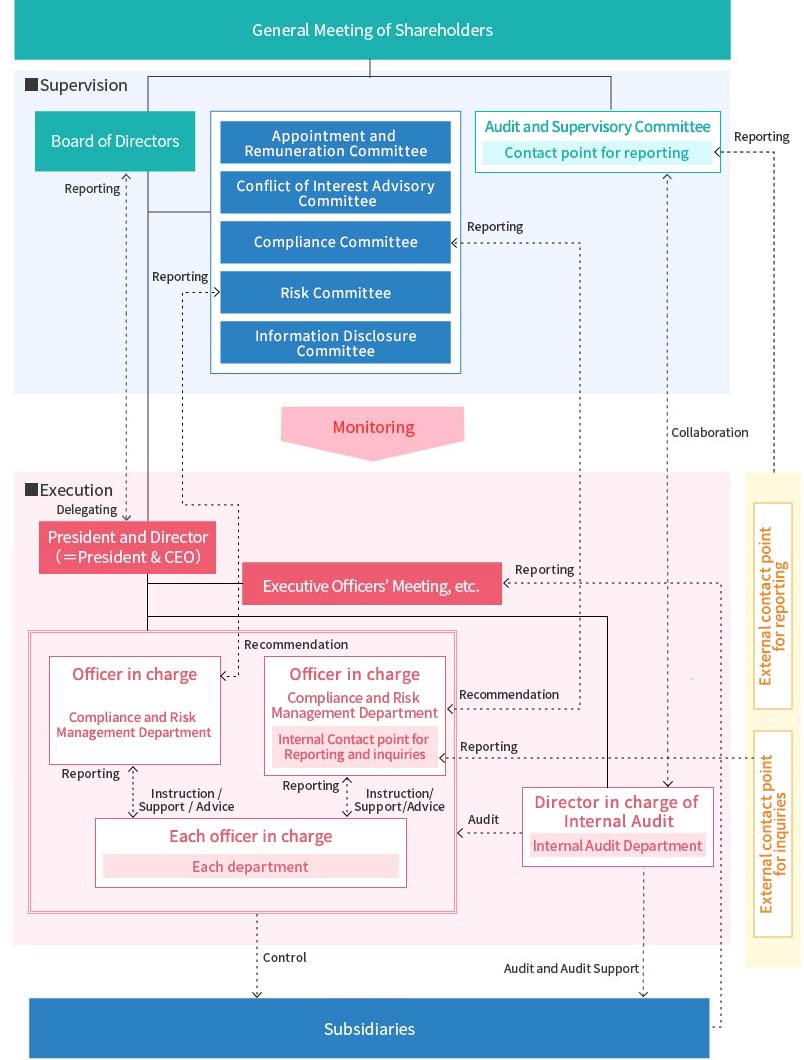
Corporate Governance and Internal Control System Structure
An overview of corporate governance structure and reasons for employing said structure
The Company is a company with an Audit and Supervisory Committee and aims to enable swift decision-making and enhance the Board of Directors' supervisory functions by significantly delegating decision-making on material business executions to directors from the Board of Directors. The Board of Directors, in turn, performs thorough monitoring and other measures on delegated matters.
The Company aims to improve the transparency and objectivity of its management by having an Audit and Supervisory Committee composed mainly of outside directors conduct audit and supervisory functions.
The organs installed by the Company are as follows:
Board of Directors
The Board of Directors of the Company consists of nine members: President & CEO Masataka Kinoshita who chairs the Board, Directors Shigeyoshi Kinoshita, Hiroshi Naruse, Takashi Kiribuchi, Yuji Kinoshita, Tadashi Yamamoto and Michelle Tan, and Members of Audit and Supervisory Committee Kikuo Asano (Outside Director), Akihiro Kiyooka and Takuji Akiyama (Outside Director).
The Board deliberates and decides important business management matters, such as management strategies and business planning, and basic policies for building corporate governance and internal control systems, while ensuring objective and rational judgment. Furthermore, the Board delegates decision-making on matters related to the execution of business operations other than matters to be resolved at the Board of Directors to President and Director, and monitors and supervises the execution of duties by thorough monitoring and other measures on delegated matters.
It meets at least once every quarter, in principle, and more as deemed necessary.
During the current fiscal year, the Company held a total of 10 Board of Directors meetings. Status of attendance at meetings of each Board of Directors member is as follows:
Name Number of meetings held Number of meetings attended Number of attendance Shigeyoshi Kinoshita 10 10 100% Hiroshi Naruse 10 10 100% Masataka Kinoshita 10 10 100% Takashi Kiribuchi 10 10 100% Tomomi Uchida*1 4 4 100% Masashi Yoshiba*2 6 6 100% Yuji Kinoshita*3 - - - Tadashi Yamamoto 10 10 100% Michelle Tan 10 10 100% Toshihiko Yamashita*1 4 4 100% Kikuo Asano*4 6 6 100% Akihiro Kiyooka 10 10 100% Takuji Akiyama 10 10 100% - (*1) This member has retired from the position of Director as of June 20, 2025. Thus, the status of attendance includes attendance at Board of Directors meetings held during the period prior to the retirement.
- (*2) This member has retired from the position of Director as of June 23, 2026.
- (*3) No data is available as this member assumed the position of Director as of June 23, 2026.
- (*4) This member was appointed to the position of Director as of June 20, 2025. Thus, the status of attendance includes attendance at Board of Directors meetings held during the period following the appointment.
The Board of Directors has determined the following items mainly as details to be deliberated in the current fiscal year.
[Details of management strategy-related matters]
- Items relating to single-year management plan
- Items relating to medium-term management plan
- Items relating to interim and year-end dividends
- Items relating to human rights policy
- Items relating to updating of materialities
[Details of business management-related matters]
- Items relating to Basic Policy of Establishing ACOM Group's Internal Control System
[Details of financial results and accounting-related matters]
- Items relating to financial statements
- Items relating to business reports
[Details of human resources-related matters]
- Items relating to the selection of the positions of Representative Directors and Directors
- Items relating to basic compensation, performance-linked compensation and stock price-linked compensation for Directors
Audit and Supervisory Committee
The Audit and Supervisory Committee consists of three members: Kikuo Asano (Outside Director) who chairs the committee, Akihiro Kiyooka and Takuji Akiyama (Outside Director).
It meets regularly to receive reports concerning important audit-related matters, hold discussions, and pass resolutions.
Committees
-
- Appointment and Remuneration Committee
-
The Appointment and Remuneration Committee consists of six members: President & CEO Masataka Kinoshita who chairs the committee, Representative Directors Shigeyoshi Kinoshita and Hiroshi Naruse, and Members of Audit and Supervisory Committee Kikuo Asano (Outside Director), Akihiro Kiyooka and Takuji Akiyama (Outside Director).
The Appointment and Remuneration Committee reviews and proposes the appointment of candidates and remuneration for Directors (excluding those serving as Audit and Supervisory Committee Members) for resolution at the Board of Directors Meeting. The Committee also checks management and the status of training for candidates for management and provides an overview of the same to the Board of Directors.
The Appointment and Remuneration Committee meets three times a year, in principle, and more as deemed necessary.
During the current fiscal year, the Company held a total of 4 Appointment and Remuneration Committee meetings. Status of attendance at meetings of each Appointment and Remuneration Committee member is as follows:
Name Number of meetings held Number of meetings attended Number of attendance Shigeyoshi Kinoshita 4 4 100% Hiroshi Naruse 4 4 100% Masataka Kinoshita 4 4 100% Toshihiko Yamashita*1 3 3 100% Kikuo Asano*2 1 1 100% Akihiro Kiyooka 4 4 100% Takuji Akiyama 4 4 100% - (*1) This member has retired from the position of Director as of June 20, 2025. Thus, the status of attendance includes attendance at Appointment and Remuneration Committee meetings held during the period prior to the retirement.
- (*2) This member was appointed to the position of Appointment and Remuneration Committee Member as of June 20, 2025. Thus, the status of attendance includes attendance at Appointment and Remuneration Committee meetings held during the period following the appointment.
The Appointment and Remuneration Committee has determined the following items mainly as details to be deliberated in the current fiscal year.
- Items relating to Evaluation of Directors
- Items relating to candidates for Directors and Representative Directors of subsidiaries
- Items relating to the selection of the positions of Representative Directors and Directors
- Items relating to basic compensation, performance-linked compensation and stock price-linked compensation for Directors
- Items relating to the status of training for management and candidates for management
-
- Conflict of Interest Advisory Committee
-
The Conflict of Interest Advisory Committee consists of three independent persons, chaired by independent director (outside) Kikuo Asano, the independent director (outside) Takuji Akiyama, and lawyer from Nozomi Sogo Attorneys at Law, Hitoshi Shimbo. The Committee deliberates on material transactions, etc. where the controlling shareholders' interest conflicts with minority shareholders' from the perspective of protecting the interests of minority shareholders and makes recommendations to the Board of Directors, etc.
The Conflict of Interest Advisory Committee meets, each time there is a critical transaction, etc. where controlling shareholder's interest conflicts with the minority shareholders' interest.
During the fiscal year ended March 31, 2025, there were no such transactions; however, one meeting of the Conflicts of Interest Advisory Committee was held to report this result, and all committee members attended.
-
- Compliance Committee
-
The Compliance Committee consists of five members: chaired by director (outside) Michelle Tan, experts from outside the Company Yasunari Takaura, Outside Director Kikuo Asano and Representative Directors Hiroshi Naruse and Masataka Kinoshita. The Committee deliberates and discusses important matters related to compliance, and makes recommendations to the Board of Directors as necessary.
The Compliance Committee meets four times a year, in principle, and more as deemed necessary.
-
- Corporate Risk Committee
-
The Corporate Risk Committee consists of five members: Deputy Chairman Hiroshi Naruse who chairs the committee, Representative Directors Masataka Kinoshita, and Members of Audit and Supervisory Committee Kikuo Asano (Outside Director), Akihiro Kiyooka and Takuji Akiyama (Outside Director).
The Corporate Risk Committee deliberates and discusses important items related to risk management and makes proposals and reports to the Board of Directors as deemed necessary. The Committee also monitors the status of risk management and other matters and reports the results to the Board of Directors.
The Corporate Risk Committee meets once every quarter, in principle, and more as deemed necessary.
-
- Information Disclosure Committee
-
The Information Disclosure Committee consists of six members: a deputy chairman Hiroshi Naruse who chairs the committee, a director Takashi Kiribuchi, a member of Audit and Supervisory Committee Akihiro Kiyooka, and executive officers who concurrently serve as directors in charge of the relevant departments, Masatoshi Nabeoka, Kazuki Morishita and Osamu Morimoto.
To ensure accurate, timely and appropriate information disclosure, the Committee deliberates on matters such as statutory disclosure materials based on the Companies Act and Financial Instruments and Exchange Act, timely disclosure materials based on the Securities Listing Regulations, and matters related to the development of information disclosure systems.
The Information Disclosure Committee meets twice every quarter, in principle, and more as deemed necessary.
Executive Officers' Meeting and other important meetings
The Executive Officers' Meeting and other important meetings consist of ten members: President & CEO Masataka Kinoshita who chairs the committee, Representative Directors Shigeyoshi Kinoshita and Hiroshi Naruse, executive officers who serve concurrently as directors Takashi Kiribuchi, Yuji Kinoshita, Masatoshi Nabeoka, Kazuki Morishita, Osamu Morimoto, Wataru Yoshioka and Masahiko Ota.
In the presence of Members of Audit and Supervisory Committee, the Executive Officers' Meeting and other important meetings discuss and make decisions related to the execution of important business operations delegated by the Board of Directors to the President and Director, and deliberates management policies and management plans in advance for resolution at the Board of Directors Meeting in accordance with basic policies determined by the Board of Directors.
The Executive Officers' Meeting and other important meetings assemble three times a month, in principle, and more as deemed necessary.
Appointment of Outside Directors and Reason Thereof
The Company has three Outside Directors. Their relationships with the Company are as shown in the chart below.
With respect to the standards for selecting candidates for independent outside directors, the Company places emphasis on how the candidates satisfy the standards regarding the independency of independent directors stipulated by the Tokyo Stock Exchange and whether or not the candidates have extensive experience, deep insight, and advanced expertise.
Name of Outside Director Relations with the Company Michelle Tan - Ms. Michelle Tan is an Outside Director as stipulated under Article 2, Paragraph 15 of the Company Law.
- She has conducted comparative research, etc. on consumer protection systems in Japan and Australia, and has many years of experience and extensive knowledge as an expert on international consumer policy. It is anticipated that she will perform her duties as an Outside Director appropriately from a neutral and global perspective as she has abundant knowledge of domestic and international consumer protection trends, gained through her career as a professor at Tezukayama University and Chief Director at non-profit organization Japan Consumer Network (JACONET), etc.
- As an Outside Director, she is expected to provide advice to be made from a standpoint of accelerating the Company's sustainable growth and striving towards enhancement of medium- to long-term corporate value based on her insight, and to supervise the management from an independent viewpoint through important decision-making at the Board of Directors meetings.
- As she meets all requirements for "Independence Standards for Outside Directors" the Company has formulated, she has been designated as an independent director.
Kikuo Asano - Mr. Kikuo Asano is an Outside Director as stipulated under Article 2, Paragraph 15 of the Company Law.
- He has a wealth of knowledge and experience acquired in the finance industry over many years, and accomplishments as a corporate manager and Outside Director. He also has considerable expertise in finance and accounting, having been engaged in related operations in his previous position. Therefore, the Company believes that he can supervise and provide appropriate advice for the management of the Company from an external viewpoint based on his knowledge and experience.
- He is expected to play the role as an Outside Director to provide advice on management policies and improvements to be made from a standpoint of accelerating sustainable growth and striving towards enhancement of medium- to long-term corporate value based on his insight, and to supervise the management from an independent viewpoint through the appointment and dismissal of its members and other important decision-making at the Board of Directors meetings.
- As he meets all requirements for "Independence Standards for Outside Directors" the Company has formulated, he has been designated as an independent director.
Takuji Akiyama - Mr. Takuji Akiyama is an Outside Director as stipulated under Article 2, Paragraph 15 of the Company Law.
- He is expected to supervise and audit the management of the Company from a neutral and objective viewpoint based on his advanced expertise and abundant experience gained in finance and accounting audits through his career as a certified public accountant over many years. Although he has not been directly involved in corporate management other than as an outside company auditor, it is anticipated that he will perform his duties as an Outside Director appropriately for the aforementioned reasons.
- He is expected to play the role as an Outside Director to provide advice on management policies and improvements to be made from a standpoint of accelerating sustainable growth and striving towards enhancement of medium- to long-term corporate value based on his insight, and to supervise the management from an independent viewpoint through the appointment and dismissal of its members and other important decision-making at the Board of Directors meetings.
- As he meets all requirements for "Independence Standards for Outside Directors" the Company has formulated, he has been designated as an independent director.
Compensation to Directors and Audit and Supervisory Committee Members
-
- Matters concerning the policy for the decision on the amounts of compensation to Directors and Audit and Supervisory Committee Members or the calculation method thereof
- The Board of Directors determined a policy concerning the decision on the details of individual compensation payable to Directors (excluding Directors serving as Audit and Supervisory Committee Members). In summary, compensation payable to Directors (excluding Directors serving as Audit and Supervisory Committee Members) is designed to sufficiently function as an incentive to aim for sustainable increase in corporate value by benchmarking the compensation levels of peer companies in related industries and segments with similar business scale. Compensation to Representative Directors and Directors serving as Executive Officers consists of basic compensation, performance-linked compensation and stock price-linked compensation, while compensation to part-time Directors consists of basic compensation only. Basic compensation is fixed compensation to be paid once monthly, performance-linked compensation is variable compensation to be paid once yearly according to business results, and stock price-linked compensation is variable compensation to be paid upon retirement according to stock price.
The Company determines the amount of basic compensation payable to Directors (excluding Directors serving as Audit and Supervisory Committee Members) at the Board of Directors after the Appointment and Remuneration Committee deliberates and proposes the respective amounts to be paid according to the position and other factors, in consideration of the compensation levels at other companies, the business results of the Company, the levels of employees' salaries and other factors. The Company determines the amount of performance-linked compensation payable to Directors (excluding Directors serving as Audit and Supervisory Committee Members) at the Board of Directors after the Appointment and Remuneration Committee calculates the basic source of distribution using "Profit attributable to owners of parent" as an indicator to make a comprehensive measurement of the results of the management, and deliberates and proposes the respective amounts to be paid according to the positions, individual evaluations and other factors. The amount of stock price-linked compensation is calculated by multiplying the number of phantom stocks which are granted every year by the stock price three years late and the Company determines as to the grant of phantom stocks at the Board of Directors after the Appointment and Remuneration Committee deliberates and proposes such grant in consideration of its business condition, etc.
The target percentage of variable compensation (performance-linked compensation and stock price-linked compensation) out of total compensation is approximately 25% (assuming a standard amount of performance-linked compensation and stock price-linked compensation). The amount of performance-linked compensation is decided by a method whereby the Appointment and Remuneration Committee first determines a range of profit attributable to shareholders of the parent company, which becomes a standard for basic source of distribution, by taking into consideration special factors such as extraordinary income or losses from profit attributable to shareholders of the parent company, and the Board of Directors determines a specific amount of performance-linked compensation by multiplying the basic source of distribution by a ratio corresponding to the ratio of distribution for each title and individual evaluation of Directors. The amount of stock price-linked compensation is decided by a method whereby the Appointment and Remuneration Committee first determines a number of phantom stocks calculated based on a standard amount set every year for each Representative Director and Director serving as an Executive Officer, and the Company determines as to the grant thereof at the Board of Directors. The phantom stocks are converted into points by multiplying the number of phantom stocks by the stock price three years later, and the points accumulated during the term of office are converted into a specific amount to be paid upon retirement.
While target figures for the indicator for performance-linked compensation have not been determined for the current fiscal year, the actual figure of the basic source of distribution amounted to 60 million yen, with the standard range of profit attributable to shareholders of the parent company from 60,000 million yen to less than 70,000 million yen.
Other details of the compensation payable to Directors are deliberated and proposed by the Appointment and Remuneration Committee and thereupon determined by the Board of Directors. The amount of compensation payable to Audit and Supervisory Committee Members is determined through consultation among Audit and Supervisory Committee Members in consideration of their duties and responsibilities. The stock price-linked compensation system (phantom stocks) decided at the Board of Directors meeting held on January 31, 2023, was introduced and started in June 2023 for the purpose of incentivizing management to demonstrate sound entrepreneurial spirit as well as further promoting value sharing with shareholders, toward the Company's sustainable growth and enhancement of medium- to long-term corporate value.
At the 40th Ordinary General Meeting of Shareholders held on June 22, 2017, it was resolved that compensation payable to Directors (excluding Directors serving as Audit and Supervisory Committee Members) per year shall be no more than 400 million yen (excluding the portion of employee's salary payable to Directors who concurrently serve as employees). The number of Directors (excluding Directors serving as Audit and Supervisory Committee Members) as of the conclusion of the above Ordinary General Meeting of Shareholders was six. In addition, at the same Ordinary General Meeting of Shareholders, it was resolved that compensation payable to Directors serving as Audit and Supervisory Committee Members per year shall be no more than 100 million yen. The number of Directors serving as Audit and Supervisory Committee Members as of the conclusion of the above Ordinary General Meeting of Shareholders was four. As of March 31, 2026, the number of Directors (excluding Directors serving as Audit and Supervisory Committee Members) was seven and the number of Directors serving as Audit and Supervisory Committee Members was three.
The details of the individual compensation payable to each Director (excluding Directors serving as Audit and Supervisory Committee Members) for the fiscal year under review were determined by the Board of Directors within the compensation limit approved by the general meeting of shareholders respecting the proposal from the Appointment and Remuneration Committee submitted upon deliberation based on the Director's position, evaluation, and other factors. Therefore, the Company believes that the details are in line with the Policy.
-
- Total amount of compensations by categories for the Filing Company, total amount of compensations by type, and the number of paid officers
-
Category Total amount
(Millions of yen)Total amount of compensations by type (Millions of yen) Number of Persons Fixed compensation Performance-linked compensation Stock price-linked compensation Directors
(excluding
Audi and
Supervisory
Committee
Members
and
Outside
Directors)253 179 53 20 7 Audit
and
Supervisory
Committee
Members
(excluding
Outside
Directors)21 21 - - 1 Outside
Directors
and
Outside
Audit and
Supervisory
Committee
Members33 33 - - 4 Total 308 234 53 20 12 (Notes)
1. There are no employee-directors.
2. "Number of persons" represents the cumulative number of officers who received compensation during the current fiscal year.
3. stock price-linked compensation is the amount reported as expenses in the current fiscal year.
-
- Total amount of consolidated compensations by Filing Company's officers.
- This is omitted as none of officers of the Filing Company received aggregated consolidated compensations of 100 million yen and above.
Status of securities held by the Company
-
- Criteria and basic stance of classification of investment securities
- For classification between investment securities held for pure investment purposes and investment securities held for other than pure investment purposes, the Company does not hold any investment securities held for other than pure investment purposes and does not have a plan to hold them in the future.
-
- Investment securities held for other than pure investment purposes
- Not applicable
-
- Investment securities held for pure investment purposes
-
Classifi
cationFiscal Year Ended March 2026 Fiscal Year Ended March 2025 Number of names
(Name)Value in balance sheet
(Millions of yen)Number of names
(Name)Value in balance sheet
(Millions of yen)Non-listed
Securities12 966 17 966 Securities
other than
the above1 0 1 0 Classifi
cationFiscal Year Ended March 2026 Total dividend received
(Millions of yen)Total gain or loss on sale
(Millions of yen)Total valuation gain or loss
(Millions of yen)Non-listed
securities15 - (Note) Securities
other than
the above- - - (Note) "Total valuation gain or loss" is not shown for non-listed securities, since they have no market values.
-
- Investment securities, of which holding purpose has been changed from pure investment to other than pure investment
- Not applicable
-
- Investment securities, of which holding purpose has been changed from other than pure investment to pure investment
- Not applicable
Promoting Prompt and Accurate Fair Disclosure
ACOM endeavors to maintain and improve transparency of management for the benefit of stakeholders through accurate and prompt disclosure of various management information. Concurrently, ACOM concentrates on diverse investor relations activities both in domestic and overseas. These consist of, but not limited to: earnings release conferences for investors and institutional analysts; individual interviews; conference calls, and overseas IR roadshow.
Results of IR Activities in FY2025Activity Number of times Overview Briefings for institutional investors (including for foreign investors) 6 Held quarterly for analysts and institutional investors.
(Briefing given by the President in the second and fourth quarters)Overseas roadshows 2 Dialogue with foreign institutional investors by the President or the Executive Officer in charge of the Finance Dept. Conferences hosted by securities firms 3 Dialogue with institutional investors by the Executive Officer in charge of Finance Dept. Briefings for individual investors 2 Holding briefings by live streaming or face-to-face Number of Dialogues with shareholders / investors 161 Total number of dialogues through the above activities, one-on-one meetings, etc. 
To view the above files, you will need to download the Acrobat Reader Adobe, Acrobat,and Acrobat logo are trademarks of Adobe Systems Incorporated.
- Executive‑led initiatives